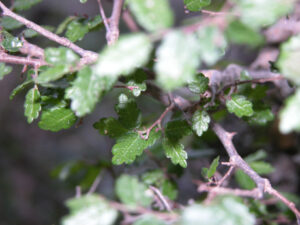
A place’s identity is shaped by its distinctive features—whether related to people or the natural world. The more of these features exist, the greater the richness and uniqueness of that place. One such unique feature of the Psiloritis UNESCO Global Geopark is its flora.
Inspired by the lifelong work of Georgia M. Xylouri—forest officer in the Forest Service of Crete and one of the Geopark’s founding contributors—we created this small travelling exhibition featuring 20 of the most remarkable plants of Psiloritis. It represents just a glimpse of the region’s vast botanical wealth.
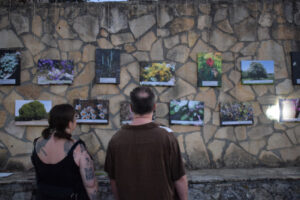
Our aim is for this exhibition to reach as many events and communities across the Geopark as possible, helping locals and visitors alike discover part of this unique natural heritage, appreciate its beauty, and protect it as it deserves.
We extend our heartfelt thanks to the photographers who provided the images, the Natural History Museum of Crete (Botany Department) for their scientific support, the creators of the exhibition, and everyone who helped bring it to life.
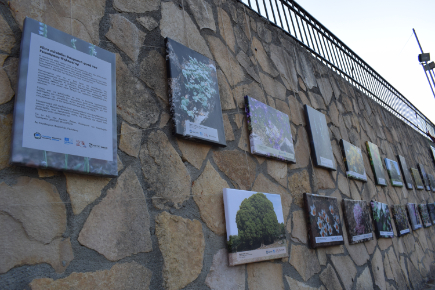
Over the years, the Geopark has hosted numerous exhibitions and publications—featuring geosites, caves, local artists, traditional myths, and more. However, a recent review by our team and collaborating institutions (such as the Environmental Education Centre of Anogeia and the Natural History Museum of Crete) revealed that the unique plants of Psiloritis have often received less attention than its wildlife.
As part of this year’s World Environment Day activities, and inspired by the work of Georgia M. Xylouri, the Geopark and its partners decided to take this initiative forward.
The goal is to introduce both residents and visitors to the fascinating plant life of the region—plants that may be rare or common, yet all possess distinctive features, remarkable properties.
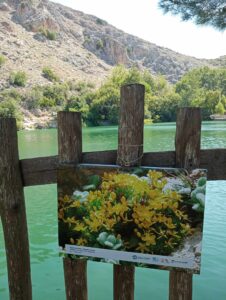
The selection was done with criteria of maximum inclusion! This concerned the geographic distribution of each species (where is it found?),its taxonomic group (in what plant category does it belong?),its morphology (what does it look like?)and the type of its special feature (for example: some are very rare, some are very common but simultaneously medicinal, others have striking morphology, etc.).
Purpose of the exhibition:
The goal is to introduce and familiarize people with some of the plants of our Geopark, with the ultimate aim of highlighting this often overlooked or underappreciated portion of natural wealth. Through this exhibition, we want people to become aware of how many, how diverse, how special, and how beautiful the plants of the Geopark are — and why their protection should concern us!
Possible Threats to the plants of Psiloritis Geopark:
- Intensive livestock grazing
- Fires – land clearance
- Replacement of wild vegetation with agricultural crops
- Climate crisis
The extinction risk assessment summarizes the risk of disappearance for a group of organisms, and is conducted according to specific scientific criteria of the International Union for Conservation of Nature (IUCN). It can be applied at global, regional, and/or national levels. As a result, species are classified into different categories and corresponding species lists (“Red Lists”) are compiled. With these tools, scientists can evaluate and plan the best possible strategies for protecting threatened species.
Categories of the Greek Red List summarized below based on information from OFYPEKA
Acer sempervirensMaple (photo by E. Avramakis):
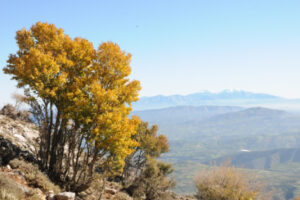
The Cretan Maple Acer sempervirensAcer sempervirens, is a species found in various parts of the eastern Mediterranean. It is the most common deciduous tree in mountainous Crete, with vibrant green or deep red foliage depending on the season, and winged seeds that are carried over long distances by the wind!
Extinction risk assessment: LEAST CONCERN
Astragalus idaeusIdaean Milkvetch (photo by E. Avramakis):
I’m still here – I didn’t go extinct like you thought!
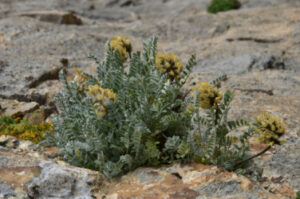
One of the rarest plants in Greece, Astragalus idaeus was first described in 1868 from a sample collected earlier on Psiloritis, hence the specific epithet idaeus, meaning “of Ida.” It was not seen again and was considered “possibly extinct” until its rediscovery in 2002 on Mount Dikti and in 2015 on Psiloritis. Today, it is considered endemic to these two mountains (meaning it exists only there and nowhere else in the world). It is related to the much more common Astragalus species.Astragalus spp.).
Extinction risk assessment: CRITICALLY ENDANGERED
Berberis creticaCretan Maple (photo by E. Avramakis):
I reign over the Cretan mountains, alongside the Kermes Oak!
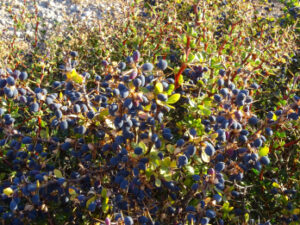
This deciduous, spiny shrub grows in dolines (bowl-shaped depressions in the ground) and rocky areas above 900 m elevation. It is found in various parts of Greece and the Eastern Mediterranean. In Crete, it blooms in May–June, and its yellow flowers later turn into small, fleshy, dark fruits eaten by small birds. It is known for its medicinal and dye-producing properties. Some parts of the plant are used in food by certain cultures, and its wood also has practical uses—but other parts are toxic (DO NOT consume!). Painful prickles — no explanation needed. The species is not exclusive to Crete.
Extinction risk assessment: LEAST CONCERN
Cephalanthera cucullataCretan Cephalanthera (photo: Ch. Fassoulas):
Beautiful, but in danger!
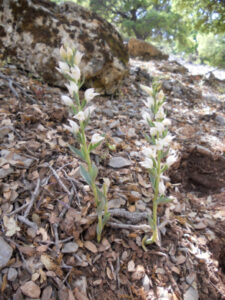
This Cretan-endemic orchid is known from the three major mountain ranges: the White Mountains, Psiloritis, and Dikti. In 1985, a 2,000 m² area in Kamares (Heraklion) was officially designated a Natural Monument, as it is a habitat of the species! This endemic Cephalanthera is one of the most endangered orchids of Crete. Cutting it is strictly prohibited, as with all wild orchids.
Extinction risk assessment: ENDANGERED
Crataegus monogynaHawthorn (photo: Ch. Fassoulas):
The Zominthos Hawthorn, so important it was declared a Natural Monument!
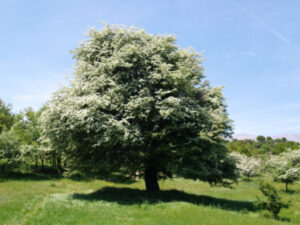
One of the largest Crataegus monogyna trees stands in the archaeological site of Zominthos and has been declared a Natural Monument for its significance. It features distinctive white blossoms and red fruits that add color to the landscape across the seasons! Hawthorn fruits are considered a superfood, and are used in liqueurs and jams!
Extinction risk assessment: LEAST CONCERN
Crocus sieberiSieber’s Crocus or Snow Crocus (photo: E. Avramakis):
I bloom with the snow — but I’m not saffron!
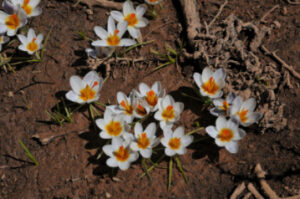
One of six Crocus species of Crete, Crocus sieberi belongs to the Crocus genus but is not saffron! It is endemic to the Cretan mountains (found nowhere else), growing at altitudes between 1,100 and 2,400 m. The name “Sieberi” honors Austrian naturalist Sieber, who explored Crete in 1817. “Snow” refers to its blooming season — early spring, as the snow begins to melt.
Extinction risk assessment: LEAST CONCERN
Horstrissea dolinicolaDoline Horstrissea (photo: E. Afrathianakis):
Tiny and rare
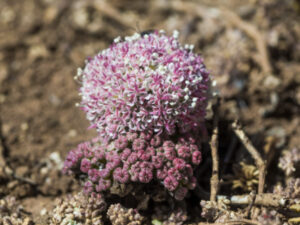
Its cylindrical root can reach up to 10 cm long, but its leaves and flower stalk grow only 2–3 cm tall! Horstrissea dolinicola is the only species in the genus Horstrissea Horstrissea which is endemic to Crete and found only in the dolines of the Petradolakia area. It grows in depressions of limestone terrain (dolines), from which it gets its name!
Extinction risk assessment: CRITICALLY ENDANGERED
Hypericum jovis– Jupiter’s St. John’s Wort (photo: E. Avramakis):
Blooming stars on Psiloritis
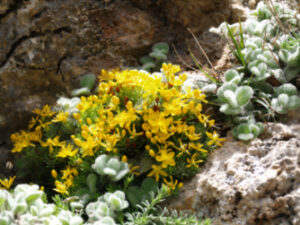
A relative of St. John’s WortHypericum perforatumHypericum perforatum, from which the well-known oil is derived), but far less abundant, making it unsuitable for commercial usejovisIt is called "jovis" (of Jupiter/Zeus) because it is endemic to Central Crete. Its star-shaped yellow petals and stamens resemble blooming stars!
Extinction risk assessment: LEAST CONCERN
Legousia pentagonia Legousia (photo: Ch. Fassoulas):
Flowers hidden among thorns!
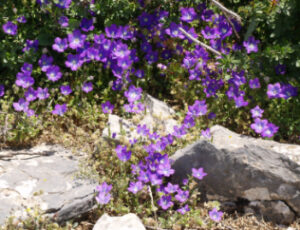
Found in various parts of the eastern Mediterranean, mainly on rocky substrates, in phrygana and cultivated areas. Its delicate flowers emerge from thorny bushes and spiny shrubs like Sarcopoterium and Genista, hiding from grazing animals.
Extinction risk assessment: LEAST CONCERN
Odontarrhena baldacciiAlyssum of Gonies (photo: E. Avramakis):
Find me on ancient oceanic rocks!
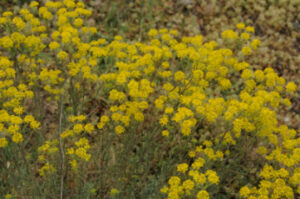
So far, this plant has only been recorded on ophiolites (rocks formed on the ocean floor in deep geological time) in certain parts of Psiloritis. Due to these special substrates, some Alyssum species have been found to hyperaccumulate the element Nickel!
Extinction risk assessment: ENDANGERED
Orchis quadripunctata– Four-spotted Orchid (photo: Ch. Fassoulas):
Count the dots — there are always four
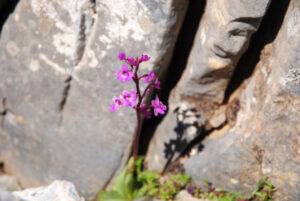
One of the most common orchids in Crete, also found in parts of the Balkans, Italy and Turkey. Its name quadripunctata quadripunctata refers to its morphology — four distinct dots on the flower. Like all orchids, it is a protected species and must not be picked.
Extinction risk assessment: LEAST CONCERN
Origanum dictamnus– Dittany of Crete or "Erontas" (photo: Ch. Fassoulas):
The herb of lovers
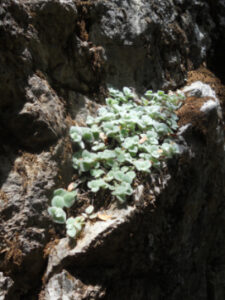
A Cretan-endemic herb (found only on the island), renowned for its therapeutic properties. It grows in crevices of steep limestone cliffs — wild and uncultivated. The nickname "erontas" (love) may refer to its invigorating properties or to its use as a gift symbolizing love between sweethearts.
Extinction risk assessment: NEAR THREATENED
Polygonum idaeum– Ida Polygonum or “Nevrida” or “Golden Herb” (photo: E. Avramakis):
The golden plant!
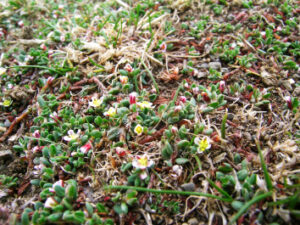
This Cretan endemic species is the dominant plant on the Nida Plateau. It is eaten by sheep, staining their teeth golden! Although it also grows on Mount Dikti, its main distribution area is Psiloritis, which is why it is called the “Nevrida of Ida.” It is a low-growing, ground-hugging plant, very common across the Nida Plateau.
Extinction risk assessment: LEAST CONCERN
Prunus prostrata– Rock Almond or Dwarf Cherry (photo: E. Avramakis):
I’m small and lovely, and I grow only at high altitudes! Look for me on the rocks…
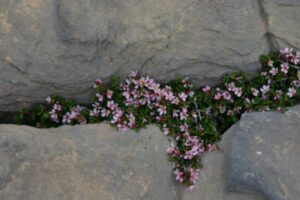
This species is found in various parts of the Mediterranean. In Greece, it grows across much of the country, usually on limestone or scattered in mountain meadows at altitudes between 900 and 2,100 meters. Its tendency to “creep” across the ground, due to the high-altitude conditions, gave it the nameprostratameaning “lying flat.”
Extinction risk assessment: LEAST CONCERN
Quercus coccifera – Kermes Oak (Prinos) (photo: Ch. Fassoulas):
I can withstand anything — cold, snow, and wind!
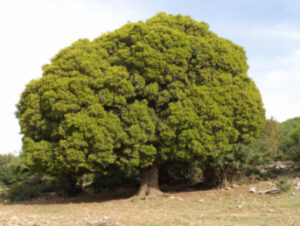
One of the most common trees in Crete and the broader Mediterranean. It is an evergreen oak with spiny leaves, showing great variability in size: it can remain a small shrub (after fire or overgrazing) or grow into a large tree. Compared to other oaks, it is particularly hardy and resilient.
Extinction risk assessment: LEAST CONCERN
Scilla nanaDwarf glory-of-the-snow (photo: E. Afrathianakis):
The flower that blooms through snow!
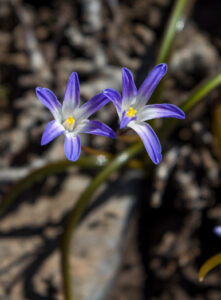
Endemic to Crete, it grows on the mountains Dikti, Thrypti, Ida, and Kedros. It is named for its flowering period, early in spring, when the snow begins to melt — it seems to emerge from a white carpet! It is a geophyte, meaning it spends most of its life underground, like crocuses, tulips, and horstrissea.
Extinction risk assessment: LEAST CONCERN
Silene antri-jovis Silene of Zeus’ Cave (photo: E. Avramakis):
Another treasure of Zeus' Cave!
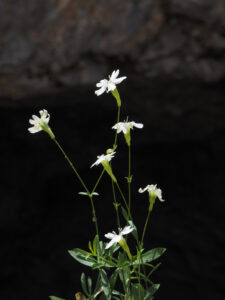
It was given the name antri- jovis(of “Zeus’ Cave”), even though it also grows in other mountainous areas of Crete, on rocky high-altitude substrates.
Extinction risk assessment: NEAR THREATENED
Spiranthes spiralis – Lady’s Tresses (photo: E. Avramakis):
The orchid that dances!
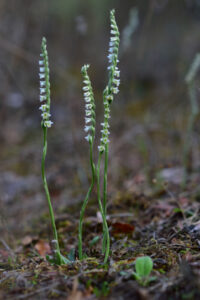
An orchid species found in Europe, Asia, and North Africa. It grows across Greece, although it often goes unnoticed due to its small size. It is the first orchid to bloom in autumn in Crete. Its name refers to the spiral arrangement of its flowers. Cutting it, like all wild orchids, is strictly prohibited.
Extinction risk assessment: LEAST CONCERN
Tulipa doerfleriDörfler’s Tulip (photo: E. Nikolakakis):
The famous red Cretan tulip!
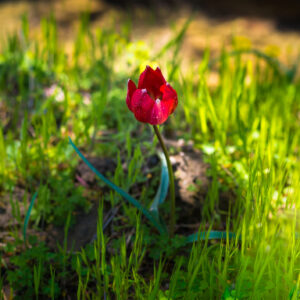
An endemic tulip of Crete, found mainly on the small plateau of Gious Kampos in Amari. It was named after Austrian botanist Ignaz Dörfler, who studied it in the early 20th century. Every spring, when it blooms, many visitors come to admire and photograph it.
Extinction risk assessment: LEAST CONCERN
Zelkova abeliceaThe Cretan Zelkova (Ampelitsia) (photo: Forest Directorate of Heraklion):
A tree from the past!
Το γένος Zelkova appeared millions of years ago! Today it survives only in some Asian countries, in Sicily, and in Crete! It also once grew in mainland Greece until 400,000 years ago. Because it looked unlike any other known tree of the Cretan mountains, locals named it anegnoro (“unfamiliar”). Traditional shepherd’s sticks (the famous Cretan katsounes) were made from its wood — a likely reason for the decrease in mature trees.
Extinction risk assessment: NEAR THREATENED